Sunday, December 13, 2009

Viva Karl Marx!

If you think this is a Communist Party demonstration you are wrong - this is a Climate Walk!))

Social planning needed! (sounds a bit familiar, ha?))

Grandpa Karl


Bright Green conference

Over the weekend the Bright Green conference took place in Copenhagen. Organized by the Confederation of Danish Industry, the exhibition "gathered 165 of the brightest and greenest companies to demonstrate that taking care of our climate also leads to the creation of jobs and new business areas. And that many of the needed solutions are available today." Vestas Windmills, next to a soon-to-be released Peugot electric car, near to the Brazilian Sugarcane Industry Association interactive video depicting their effectiveness in challenging an oil-based car industry in Brazil, across from Shanghai Grandway Limited booth boasting eco-friendly oil field equipment, below the segway test track. Anyone say green washing?! The conference was opened with speaches from Denmark's Prime Minister, US secretary of Commerce, IPCC chairman, and the crowned-prince of Denmark and Norway and the crowned-princess of Sweden. Check the video below to hear about Sweden's crowned-princess and the blunder made by the MC when referring to the Prince of Norway:


http://www.youtube.com/watch?v=5XF0U_l9fFo

Quote of the day

" We've made a basic medieval error and been foiled by a moat" - Tyler Adkins as we tried to find our way from the Bella Centre to the march and found our paths hindered by a large manmade water way.

We the World expect a real deal


Whilst 40,000 people marched in the cold through Copenhagen yesterday afternoon, the participants still inside the Bella Centre were invited to attend in a more modest and tranquil demonstration. In an all too rare moment of unity a small group NGOs, and children were joined by Parties and Secretariat for a candlelit vigil outside at the Climate Rescue Station to listen to Climate Campaigners.
A number of LUMIES were drafted in at the last minute to assist by distributing tea and cocoa (it was freezing!), lighting candles and welcoming attendees. I think we all agreed it was worth the sub-zero temperatures.


Lest we forget that World Leaders come in many forms and not just as elected politicians, Desmond Tutu elloquently, compellingly and in his own inimitable style reminded everyone that the whole world will be affected by climate change and consequently the world must come together to convey that we expect a real deal to be made at Copenhagen. I tried to paraphrase it but its probably better to listen to the man himself.
I dont normally get gushy about things like this but Archbishop Tutu was truely inspirational and I am so happy to have been a part of this small but special action.


Saturday, December 12, 2009

Summing Up From Copenhagen Business Day


The best thing that ever happened to climate negotiations, according to Yvo de Boer, was when Russia closed the gas pipe tap to Ukraine. That made us put at least three items on the climate agenda, said Yvo:
1) energy prices;
2) energy security;
3) climate change.

Yvo de Boer challenged the businesses, present at the headquarters of Confederation of Danish Industry yesterday, with a call to increase their attractiveness to negotiation process by offering the product. Current negotiations, according to him, primarily focus on obligations and commitment for public actors but you almost can't hear anything about the role of private sector. As it is now, businesses influence the policy on a national level, through new technologies for example, but not on international level. To change the situation, you need to find linkage to institutions, said Yvo.

Some comments from businesses followed:
- transition to low-carbon future is a marathon not a sprint, so it's hard to offer an immediate product or an immediate solution;
- business and government don't think along the same lines and that is another challenge;
- it's not about our ability to formulate the message but rather to define who we are selling it and what we are selling (the comment from the Head of Confederation of Danish Industry);
- we should talk more about green growth;
- we want to focus on users; what we ask from governments is to help us develop necessary instruments for this;
- we need clear, long-term framework and clear targets;
- inertia in the existing capital stock is a problem;
- public private partnerships can be very effective;
- multi-stakeholder approach is important, i.e. we need to communicate across communities and different sectors; and
- business needs one voice calling for government framework now.

Session with CEOs (on the photo)

Global carbon trading and carbon pricing were another hot topic on the agenda. Businesses hope that a price on carbon will be set soon. However, there were some doubts expressed in regard to whether it will change consumer behavior.

A couple of interesting facts mentioned during the work stream I attended (immediate actions by 2012):

- 93% of energy demand between now and 2030 will occur outside the OECD (according to the Head of International Energy Agency);
- we need to get the carbon prices right by 2012!
- price signal is still not there for recycling - e.g. it's more expensive to recycle plastic than to use a virgin one, not to mention user preferences as an obstacle for recycling.

What was reassuring is to hear some business voices saying that we need to address climate change across the entire supply chain, with Coca-Cola and Unilever announcing a pilot project with the World Business Council for Sustainable Development on establishing a low carbon supply chain.

Among other, Yvo de Boer urged businesses to set more ambitious target for innovations, for example, on the basis of 50% carbon emissions reductions as opposed to 20 or 30% (incrementalism!). He also mentioned that business community should talk from North to South. Wrapping up his session, Yvo said that, by the end of next week, we will get an architecture and design for what we are to do after Copenhagen, rather than a clear cut climate agreement.

Friday, December 11, 2009

The Right Stuff

Yesterday the Universal Declaration of Human Rights celebrated its 61st birthday, I celebrated by attending my second talk in 2 days on the issue of Human Rights and the Environment. Present at both events were Martin Wagner of Earth Justice and Ulrik Halsteen of the UNHCHR. The first event took place in the Klimaforum (dubbed the “alternative conference”) whilst the second was held in the roasting and packed COP15.

Both focused on the Human Rights of indigenous people (mostly because Martin was part of the team who petitioned the US on behalf of the Inuit people). The idea that came out of both talks was similar i.e. climate change is detrimentally affecting the Human Rights of many indigenous peoples (not least the Small Islanders and Inuit people). We were given examples of various rights which will/are being infringed by climate change and these included:-

· Right to Life
· Right to a Means of Subsistence
· Right to Water
· Right to Property and to the Use of Traditional Lands
· Right to Preservation of Health
· Right to be Free from Discrimination
· Right to Culture

It was argued that Human Rights change the plight of indigenous people from a moral issue to a legal obligation and a draft amendment to the negotiating text was distributed. (I am going to get an electronic copy so if you want a version drop me a mail). As a lawyer, of course I am interested in how we can utilise establish laws and legal process to further the fight against the effects of climate change. Additionally, of course, I also feel that Human Rights can provide an additional democratic flavour to the climate change debate, allowing individuals to enter the debate and challenge Governments on their legal imperatives to act to protect their citizens rights. I think this is an extremely powerful but yet underutilised tool and I would like greater recognition (especially by NGOs) to this aspect of the debate/cause.

However that’s not to say that this whole debate doesn’t raise some issues for me.
  1. Human Rights law should (of all law) be fundamental and open to all. At the Klimaforma questions were emotive, strong and very personal, however, there was certainly an air of extreme frustration with regard to lack of access and perceived disregard for this important area . The representative of the UNHCHR was considerate in his response but in my eyes found it difficult to explain the legal limitations with regard to litigation and enforcement of these rights (not least in terms of jurisdiction and legal capacity). At the COP 15 the questions were certainly more measured and clinical and focused heavily on legal definitions (i.e. the definitions of climate refugees as opposed to displaced people because of climate change – the difference, the former having a home to go back to). The responses were also far more measured and legal. It is apparent to me that Human Rights law is becoming yet another “exclusive” area where those who have the power are those with the technical expertise in the law. Much as money has the potential to exclude many from engaging in the market process, required legal expertise is becoming dangerously close to excluding those passionate about climate action from the human rights process.
  2. My second thought was related to this exclusion; second only perhaps to environmental regulation, Human Rights law is one of the most prolific areas of international treaties. Many rights are outlined in more than 1 treaty or Declaration, there are numerous regional and national HR legislations. This all for rights which, in not only my belief, are inherently enshrined in International Law without the need for any written legislation at all. I couldn’t help but think the introduction of additional text and more brackets to the document, as well as obfuscating the already confusing field of human rights in relation to climate change, would not add to quest for a fair and effective treaty but rather complicate and slow this already protracted process.
  3. Which brought me to thinking about this blog’s (or maybe just this blogger’s) favourite topic; the process. Why after 61 years do we still need to explicitly explain in all international treaties that where there are issues of human rights these rights should be protected? Almost immediately after the hot and sweaty HR event, I went straight to the even hotter and more overbearing REDD plus analysis event hosted by conservation.org. I don’t know much about REDD, let alone REDD+ so a lot went over my head, however, one question raised by a gentleman from Nigeria (who represents a localised NGO) did get me thinking; he asked how the conference could adopt a policy mechanism that contained so much potential for the exclusion of poorer nations, especially African nations, because of onerous bureaucratic and capacity building obligations. The Chair’s response was interesting; he stated that of course if the REDD mechanism or any proposed mechanism is excluding any countries, the it is an inappropriate mechanism. This made me think, why does the International Community insist on employing a process which naturally excludes the rights and opinions of women; indigenous groups; youth; the poor; and even the values of basic human rights to the extent that we must forcefully determine that they are included in every treaty, surely this process is an inappropriate process.

(also because I like to think that I am a fairly reasoned person I am going to acknowledge at this point that no I can’t think of a better process either and any process (even if somewhat artificially democratic and unlimited) is better than no process at all).

    Top Cop Facts

    Everywhere you look and every event you attend, COP participants are bombarded with facts and statistics most of which mean absolutely BA to me. However every so often a fact hits home (even if it is just quirky). Some people work best with numbers so for you, on this post I will continually post Top Cop facts. (I’ll try and post the source where I can but repeat my mantra of “cant do shorthand so duff reporter”).

    1. 10,000 people migrate to Mumbai every day (speech by Ruchi, Youth Representative)
    2. 45% of Panama is forest. 34% of these forests are within indigenous areas (event by conservation.org)
    3. 1.3% of the Earth’s land can be found in Indonesia, a lot of this land is forest. This forest accounts for 11% of the Earth’s plant life and 10 % of animal life. Indonesia suffers the 2nd highest rate of deforestation in the world (second only to Brazil) and accounts for 80% of the countries emissions.
    4. The key to understanding Algae is the strands. There are 35,000. You have to pick the right one. (Carbon Trust speech)
    5. Airlines are currently making a $4 billion loss. Telepresence companies are making a $39 billion profit. (Carbon Disclosure speech)
    6. Cities are responsible for 75% of the world’s emissions and account for 50% of the world’s population (Opening Speech to the COP by Ritt Bjerregaard, Major of Copenhagen)
    7. The average Life Expectancy of Cuba is the same as that of the United States. The average American income is 9 times that of the average Cuban. (Talk by Tim Jackson at the Klimaforum)
    8. 80% of the lifetime carbon emissions of computers and mobile phones is produced before we even take them out of the box (The Bellona Centre)
    9. Despite 15 years of climate negotiations, growth in emissions in the 00s has grown 33% faster than in the 1990s
    10. 1 in every £4 spent in the UK is spent in Tescos. (UK event on the Low Carbon Economy)

    GHG meter


    Another quote from Yvo today


    During the meeting with businesses at Copenhagen Business Day:

    "It's always good to send me a message but, quite frankly, I'm not going to change the world."

    Couldn't resist...


    'Supreme Master Ching Hai is the author of many insightful books, including The Birds in My Life, which, for six consecutive days, held the top spot on the international bestseller list in the general category on Amazon.com.'

    I do not believe this. The book, however, is worth $18!

    Description of the Bella Center

    Here is an interesting link about what its like in the Bella Center from BBC. It is a bit pessimistically British (sorry Maddy) at times, but illustrates the overwhelming size of this conference. The food is great and getting through security is a breeze.

    http://news.bbc.co.uk/2/hi/science/nature/8407760.stm

    Yvo De Boer


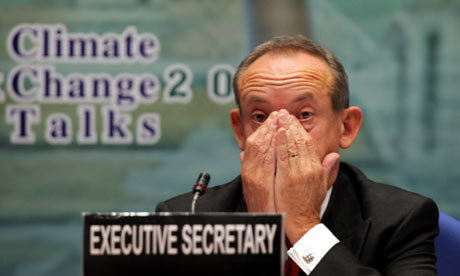
    One interesting occurrence associated with this conference is the sympathy that it has inspired within me for the ever-depressed executive secretary of the UNFCCC, Yvo De boer.

    His comment in the Youth session yesterday (that the Lawyer posted below) - 'Trust is something you earn and not something you are given. This process has still to earn my trust', really made me appreciate that this is a man who has his feet planted firmly on the fetching blue carpets of the Bella Centre, for better or for worse. The poor man has a hard and unenvious job, but at least he's willing to speak out (albeit indirectly, but I don't think it takes much artistic interpretation of above comment to reach this conclusion) about what we all know deep down inside anyway: the negotiation process is clumsy, biased and flawed; by the nature of the way the UNFCCC works it is almost objectively impossible to reach a fair and binding agreement from the structure of the COP conference.

    But we try anyway.

    If I was Yvo, i'd probably be walking around with a gloomy expression and a black cloud on top of my head too. Seriously, someone needs to give him a hug though. Does he remind anyone else of a very sad looking bear?

    Thursday, December 10, 2009

    CDSB cocktail at the Crowne Plaza


    This business party was everything but relaxed and entertaining. Rigid, slick-backed-hair, straightfaced parties are not the most desireable place to be for students. The most exciting part, other than the 2 square centimeter crackers with smoked salmon, was studying the sponsorship of the research into emission trading schemes.

    Clearly, Volvo, Shell, Carbon Trust, HoneyWell, and Entergy are interested in learning how their coal/oil etc. interests may be affected by the future carbon trading programmes. Then there is WWF...

    Mustache Of The Day Award


    You can feel the presence of the USA when visiting their own section of the Bella Center. Most countries will hold one or two side-events (usually just a presentation of some advancement they are doing in terms of battling climate change), but the US has their Center, Brazil has their 'delegation area', and EU has their Pavillionheir.

    I went to one of the US Center Science on a Sphere event about development and transfer of technologies. It included an IGO, 2 private development companies, and a USAID representative. The main point is that effecient transfer of technology to lighten the carbon footprint in developing countries need both the private and public sectors.

    Im pleased to announce John of winrock.org wins the mustache of the day award!

    How old will you be in 2050?


    Today there was a focus on young and future generations at the conference, and in the early afternoon "youth" was given a chance to speak with Mr Yvo De Boer. A number of young people spoke and "adult" members of delegations (and Mr De Boer) responded.

    I (and Ginger) were sat beside a social anthropology PhD student who, before the speeches began, asked us some thought-provoking questions; What role do youth play at the conference? Is there more to the youth movement than the flamboyant "actions" that are played out in the NGO arena each day? Given that we rarely hear about youth driven policies is there a deficit in the communication of the youth agenda i.e. do only the boisterous get a look in? and finally what will youth's role be going forward in international negotiations? Ginger and I gave woefully inadequate responses but it certainly gave us something to think about for the next 90 minutes...

    The first and most passionate speech was from Ruchi, an Indian girl, who told of her own experience in Mumbai's 2005 deadly floods. She asked political leaders whether they had the gumption to lead us in a low carbon society and she proclaimed that young people were relying on the negotiators to come to an effective agreement for climate change. She focused on the trust installed in these leaders from all young people to reach a just deal and her emotional oratory received a standing ovation from many. The stray butterfly in the room certainly made it compelling stuff.

    Mr De Boer was given the chance to respond and offered succinct and sage advice. He said (and I paraphrase because I cant do shorthand sorry) I am worried. Worried that you have emphasised the strong trust you have that an effective agreement will be reached. Trust is something you earn and not something you are given. This process has still to earn my trust. An interesting statement by itself, but all the more intriguing when analysed with regard to the social anthropologists questions.

    I think few would debate that the presence of youth at the conference as a reminder to negotiators of those who will truely be effected by climate change is vital. Not least because youth's inexperience and hope allows more radical debates to be discussed in the interests of education. However, questions can be asked as to how can youth most effectively use their position. Is it sufficient for youth to provide a vocal and pertinent reminder that they must be considered in deliberations? Or should youth take an active role in suggesting policies and critically analysing (both positive and negative aspects) of the proposed regime? My current perception is that if the latter approach exists, there is a danger that it is being drowned out by snappy slogans.

    This was highlighted in this afternoon's event. The second youth speaker was a young guy named Thomas (sorry didnt catch his last name or home country). He gave a less emotive more restrained speech which called for better technology, competitive clean energy and approaches which encouraged mainstream voices of both companies and individuals to join together to combat climate change. He asked for a shift in discussions from the "right to emit" to the "right to take part in what comes next" and he called for youth to become the first ever global generation. It was a call to action but action of a somewhat different nature than that traditionally associated with youth movements, perhaps no better or worse but certainly different. Unfortunately by the time Thomas' took to the podium the numbers in the room had reduced and he wasnt given the priviledge of a response from Mr De Boer. Nor, much to the pity, did he receive a standing ovation.

    At the end of the session a document was passed around which highlighted and reinforced the youth position to the negotiators (please see attached photo). Whilst fundamentally a sentiment based document - there are no CDM amendments or alternatives mentioned here - I think it offered an interesting insight into how youth can become or is becoming (hopefully) more engaged in the process through interaction rather than reaction.

    I have no doubt that youth are closely following the negotiations and have a greater insight into the process than perhaps media reports would suggest (you only have to look at the fossil of the day and adopt a negotiator to realise that) however at this moment my perception is that youth is relegated to critising the process and dealing with large moral issues rather than being given the ability to suggest possible solutions to the problem. Surely this is the only way in which youth can truely engage in the process and ultimately determine our own future.

    I'm clearly very new to the international youth scene so I look forward to learning more about it in the coming days!! I'd also welcome and encourage comments with other people's perceptions. (if you haven't given up reading this extensively lengthy post...)

    We don't give awards for just showing up...

    The Whole Funny Marriage-Divorce Conversation Between EU (Sweden) and Argentina


    Took place during another contact group meeting on potential consequences of mitigation actions under Kyoto Protocol.

    The main discussion revolved around 2 options of paragraph 9 in the text, the main ideas of which are:
    EITHER
    1) Annex 1 parties should support non-Annex 1 parties to minimize negative consequences and to maximize positive consequences through strengthening their institutional capacities and regulatory frameworks
    OR
    2) Non-Annex 1 parties should strive to strengthen their institutional capacities and regulatory frameworks in order to minimize negative consequences and to maximize positive consequences of mitigation actions. In this respect, Parties should share information and best practices, and, where necessary, Annex 1 parties should support non-Annex 1 parties.

    At some point, Argentina put forward a 3rd option, which it has called "a marriage between two options", basically combining exchange of information and sharing best practices with support from Annex 1 parties to non-Annex 1 parties. EU said that, in this case, it wants a divorce))

    Saudi Arabia has been very deconstructive during the whole meeting doing everything possible to keep all brackets and delay the process. For example, they claimed that they don't fully understand the meaning of the word "careful" (careful design).

    Spokesperson from G77 (South Africa) didn't show up at all (that's why the meeting was delayed by 30 mins). The countries from this group spoke on their own behalf (that's where we got a marriage proposal from Argentina).

    While wrapping up the meeting and setting time for the next session tomorrow, the Chair addressed the Parties with a quote from Britney Spears, "Give me more, please give me more!"))
    More news on this topic will follow!

    Outside and Inside Bella Centre Today

    In defence of indigenous peoples rights!


    Black Carbon as a Cause of Arctic Ice Melting


    Yesterday I’ve been to an interesting side event on black carbon and its influence on Arctic ice melting. The event was hosted by Bellona (www.bellona.org) and a number of people gave presentations, including a guy from Greenpeace Russia. Agricultural burning in Russia, apart from releasing carbon in the atmosphere, creating soot clouds and posing risks for human health, was said to be a cause of 97 percent of forest fires. The black carbon stays in the atmosphere from several days to several weeks, but is an immediate cause of global warming, also Arctic ice melting. The practice of soil and agricultural waste burning seems to be firmly established in agricultural practices in Russia (also in Ukraine and other post-Soviet countries). The main difficulty, according to Vladimir Tchouprov, is to influence the behavior of people and to change social norms, since agricultural burning – warming the soil in spring and creating immediate fertilization, also helping to get rid of wastes in the fall ­– is perceived as something absolutely conventional and normal by farmers and ordinary people, despite the problem of forest fires is as acute as ever. It is also not brought up to a higher level to be seriously considered by federal government and parliament. It seems like there are no or not adequate provisions in the federal law relating to limiting agricultural burning and setting the rules for its regulation (clear procedures for farmers to follow, if not banning at all). Greenpeace Russia hopes to influence the situation through working with government and public education for farmers (surprisingly not started yet). The presenters agreed that encouraging farmers to refuse from agricultural burning should be combined with some incentives (like subsidies) or other alternatives to make this more attractive, for example, teaching them how to convert agricultural waste to alternative energy.

    Potential of including black carbon into the future climate agreement is quite low, according to presenters. The issue is discussed but is not a part of negotiations yet, despite that, in a short-term perspective, this is the quickest possible way to reduce global warming.

    REEP and Carlsberg Brewery


    The public was invited to an open beer tasting at Carlsberg Brewery of Copenhagen. As the organizer from REEP stated: there were delegates from China, Ghana, India and others getting 'lubricated' and opening up to discussions.
    Social events outside of the formal conference can prove to be very important when it comes to diplomatic relations and positive construction towards firmer negotiations.

    Wednesday, December 9, 2009

    Pictures

    Day three at COP15 in pictures.

    Young Friends of the Earth!


    Demanding climate justice and more stringent targets for Annex 1 countries

    Live Actions at the Entrance to Bella Centre today

    African Dances by Theater for Africa

    ActionAid demanding justice and protection for developing countries


    Tuesday, December 8, 2009

    One Africa, One Degree or Suicide


    Within the Bella Center there are demonstrations left and right. I usually skip past because its just another American, Canadian, Australian or another familiar organization demonstrating. Sometimes I wonder if demonstrations are just some rich kids from developed countries trying to get involved. Here was an attention getter!

    One Africa, One Degree, or Suicide! They scream after explaining the drought of 5 years that has left them hungry.

    Sponsership


    Sponsership of the United Nations Framework Convention on Climate Change. I suppose they have to come up with 45 million Euro(budget for 2010-2011) somehow.

    http://unfccc.int/resource/docs/2009/sbi/eng/02.pdf

    Climate Scoreboard

    Another interesting thing to come out of the "Current Science Talk" - see response to Maddy's earlier post re deniers - was the contribution by Robert Corell and his collaboration with the Sustainability Institute; the Climate Scoreboard.

    Basically the Climate Scoreboard estimates the potential temperature increase based on current negotiation stances during the conference. If any major concessions (or rejections) are made the scoreboard will adjust accordingly.

    Hopefully this widget will work. If not, could someone who is more technologically minded try and upload it to the blog. I think it is great!

    NGOs meet Europe

    This afternoon Europe's NGOs lead by Climate Action Networks Mathias Duwe met with chief European Union Negotiator Anders Turesson to discuss the EU's position in the negotiation.

    As would be expected there was much discussion on establishing that any new EU finance initiates should ensure the allocation of new and additional funds rather than the reallocation of existing schemes. Certain representatives also pressed Turesson for an announcement on medium term goals. They were concerned that with all the discussions on short term focus and long term goals that there would be a deficit in the transitioning from one to the other (which actually is a point never really occured to me before...) Paul Cook from the Tearfund in the UK requested that the EU unilaterly offer numbers on how much additional ODA it would provide under any new agreement. I think this seems most unlikely from Mr Turesson's response...

    There was also call for the EU to amend its current leveraging position with the US and China by offering to reduce emissions from 20% unilaterally and 30% with the US and China's support to targets of 30% and 40% respectively. It was suggested that the EU had already let the cat out of the bag on its willingness to reduce emissions by 30%and if it failed to do so it would lose legitimacy. Consequently a new more stringent leveraging target would be appropriate. Mr Turesson said that there was no agreement on this currently but did acknowledge that maybe they had made the suggestion re 20/30 too early.

    Given the events of the afternoon (see Guardian) a particularly interesting point was raised about the EU's goal of a single treaty. Mr Turesson noted that the ultimate goal of the EU was integrity and efficiency of the treaty but he did acknowledge that the EU also required a multilateral approach and didnt want just an EU treaty. To that end, he said they were open to rational arguments for adoption of an amended Kyoto protocol and treaty.

    My thoughts on the whole thing...
    I actually found it very reasoned and well argued. The EU is clearly proud of its role as a foreward thinking block and is keen to reach an effective agreement. That said, of course they could be doing even more and providing futher clarification and transparency with regards to their proposals but all in all I felt reasonably pleased to be an EU citizen.

    Celebrity of the Day!


    None other than Josh Darrach, cofounder of the Canadian Youth Delegation, was caught giving an interview with the Chinese press explaining the Fossil of the Day award!

    And the prize goes to Ukraine, Ukraine and Ukraine))

    Ukraine has won "fossil of the day" today - one could say "privatised" the whole prize - occupying both the first and third places on the pedestal and also being somewhat attached to the second one as part of the Umbrella Group.
    Fossil of the Day is a mock award given by NGOs (every day during COP-15) to a country or countries doing the most to obstruct progress in the global climate talks, for their lack of ambition to cut carbon emissions.
    As a Ukrainian, I feel like I'm buying the third place/blame/shame - this year we've sold our carbon emissions quota under Kyoto Protocol till 2012 to Japan for USD 300 million and nobody knows where that money went/goes/will be going)) (Should be directed for JI projects.) But I'm quite ambivalent on the first one - we're blamed of selling "hot air" and having an emissions reduction target of 20% compared to 1990 level, while our emissions since then have fallen by over 40% due to decline of industry after collapse of Soviet Union. Yes, we probably should be more ambitious and proactive on implementing cleaner production technologies but we want to give green light to our industry to revive. It is not 100% fair to punish us for the collapse we faced in the 1990s..
    May be, somebody else should write this post instead of me.. But that's how I feel.

    P.S. Yes, Umbrella Group took a second place for subsidies to oil and gas industries.
    P.P.S. By the way, they're holding Ukrainian flag upside down))

    Fossil of the day!


    Fineally at COP15!

    At the REDD-session the Philippines surprisingly stated that they would like to see the paragraph about indigenious people back into discussions (apparently it was removed in Barcelona). To me this is a a bit weard since the Philippines is not exactly great at protecting and promoting their indigenious people... rather discouraging them and leaving them unprotected to the forces of foreign (and local) interests...

    well, enough about the Philippines; the winner, and third runner up for the fossil of the day is.....: UKRAINE!!! Nadiya will probably fill us in later on her country's victorious day...

    Just a teaser:

    Post-Kyoto Negotiations


    I'm now in the meeting of the Contact Group on Potential Consequences for consideration in relation to Further Commitments for Annex I Parties under the Kyoto Protocol. I have text in front of my eyes (it's about 6 pages) and most of it is still in brackets. It's quite a boring meeting, I should say, there's a lot of arguing about the wordings and it doesn't seem like negotiations are moving any further. So far, almost no brackets have been lifted. The Parties couldn't decide, for example, on the bracket "[striving to minimize] [minimizing] the adverse impacts of mitigation actions is a common concern of both developing and developed countries".
    The same talks about weak and strong formulations... Oh, well, the text is becoming even more red than before))

    P.S. The Chair of the meeting was obviously quite obsessed with the fact that he is not dressed up (he was wearing a casual blue sweater) and mentioned at least twice that this is through the fault of SAS that lost his luggage))
    P.P.S. Delegate from one of the parties asked the Chair to repeat the whole argumentation that led to one of the proposed wordings, saying that "we couldn't hear what you said because we were talking to each other"))


    Live Actions in Bella Centre

    A magic scarf that will help to offset GHG emissions from airplanes

    Green Men Looking For the Climate Leaders


    The skeptics have made it to Copenhagen.

    Climate change denial seems to be constantly lurking in the background of negotiations. In particular, the recent UEA scandal has become a hot topic for discussion, allowing skeptics to claim that the scientific basis for anthropogenic global warming has been undermined. Yesterday, Saudi Arabia's chief negotiator Mohammad Al-Sabaan argued that what has now been nick-named the 'climategate' affair would have a 'huge impact' on the outcome of negotiations at Copenhagen, telling the BBC that "it appears from the details of the scandal that there is no relationship whatsoever between human activities and climate change". Adding fuel to the fire is US-crackpot Sarah Palin, who has called for Obama to boycott the talks due to the 'junk science' that has been exposed by the recents hacks.

    With such strong attack invariably comes defence, and the backlash has already begun. In what may be an attempt to stop the debate escalating further, the UK's Met office will shortly release a dataset taken from nearly 2000 weather stations worldwide that confirms the last decade as the warmest in 160 years. Rajendra Pachauri, head of the IPCC, mentioned the climate scandal in his opening speech to the COP15 conference yesterday, urging delegates to view recent events solely as an attempt to undermine the IPCC and independent institutional findings worldwide. Likewise, our good friend George Monbiot has released a blog on the Guardian Website that documents the ways that the climate denial industry has tried to influence scientific findings on human-induced climate change.

    It seems that even within the climate talks, anthropogenic global warming has yet to be legitimised. Let us hope that debate about climate science and the UEA scandal does not prove to be an obstacle in reaching a binding agreement in the coming weeks.

    Monday, December 7, 2009

    Help Us Turn Copenhagen to Hopenhagen!

    During the opening ceremony, Lars Løkke Rasmussen, the Danish Prime Minister, among other, mentioned that there will be no bottled water in the conference and mainly organic food will be served. No souvenirs in the conference kits! "We've decided to cut on the presents - that allowed us to direct the saved funds for 11 scholarships to bring students from around the world to study sustainability and climate change in Denmark," says Rasmussen.

    Ritt Bjerregaard, the mayor of Copenhagen, addressed the public with the following words, "We have a vision that Copenhagen will become the first carbon neutral capital in the world by 2025. We aim for 20 per cent emissions reduction in the period of 2005-2015. Please help us turn Copenhagen to Hopenhagen! Please seal the deal!"

    And, as Rasmussen put it in the end of his speech, "We must deliver by the end of the conference a better future to the world. Let's be constructive and realistic. Ambitious, courageous and visionary! The deal is within the reach! Let's accomplish what we must accomplish!"

    Wait and see in two weeks, won't we?

    P.S. Had a chance to chat with a Dutch delegate during the Nephew concert on City Hall Square today who refused to comment on feasibility this, of course ..)

    CDM:- for better or for worse?

    Today I attended the EU side event on CDM and changes to the carbon market proposed by the EU in this negotiation. The panel consisted of 2 of the members of the UK delegation; a couple of lawyers from Allen and Overy; a guy from the Peruvian Delegation ( Jorge Alvarez) and a chap from SGS.

    Basically it appears whilst a couple of alternatives to CDM (or perhaps just a couple of suggested improvements...) have been proposed by the EU, these proposals pose the same problems or similar problems as the previous Kyoto system i.e.

    1) they are difficult to comprehend
    2) they dont propose speedy results
    3) they are subject to manipulation

    The new schemes have attempted to amend such problems by providing more transparent and flexible multi-sectoral solutions with appropriate MRVS(Monitoring, Verifiying and Reporting schemes). However even these schemes are subject to major issues regarding capacity building and finance.

    I dont pretend to be any form of expert on CDMs and carbon markets but it in part seemed to me that the EU's proposals try to solve the CDM problems by providing other schemes which address the problems in part but are still far from flawless and subject to major criciticsm. Even these new schemes will require stringent baseline implementation, consideratble investment in capacity building and considerable additional regulatory measures to make a significant impact.

    From my perspective the most interesting aspect of the 2 hour seminar was the fact that very few (if any) African delegations or NGOs were present and the conversation was dominated by European stakeholders (although it should probably be noted that noted everyone was for CDM; Friends of the Earth posed a number of questions highlighting the issues with the project not least the lengthy timescales associated with such schemes).

    I was sitting next to Rowena Mason (reporter from the Daily Telegraph (a UK newspaper) who has yet to upload anything on the particular side event but did post an interesting article earlier in the day. Should she write anything on today's event I will, of course, upload the article for your perusal.

    Hopenhagen


    After the official pleniary of day 1 all participants of the conference were shuttled to Copenhagen's city hall for wine, juice and sandwhiches to celebrate the opening of Hopenhagen.

    It makes you wonder how much outside functions can play on the inter-delegation relations. Even interactions with NGOs, which are often young and filled with ideology and energy. It brings everyone to the same level socially benefitting everyone. (oh and there's free food.)

    The Bella Center


    The rest of the massive convention was filled with an ocean of people including NGOs, delegates, IGOs, and staff. Laptops and food are everwhere. Laptops to connect to the outside world, the food to connect people face to face. Deliberations are everywhere

    Take Action To Stop Climate Change!


    Climate Youth activists dancing and chanting inside COP-15!


    Today was the opening day of the conference beginning with a Danish introduction and speeches by the leaders of the conference including the executive secretary of the UNFCC, the prime minister of Denmark, the mayor of Denmark, and the IPCC chairman (the science body of the UNFCC).

    It was a morning of traditions and formalities where the new chairwoman, Connie Hedegaard, of the conference works on her mallet-whacking skills and figures out how to deal with complex points brought up by delegates. One of the most interesting moments in the morning was the first speaker to the floor, Papua New Guinea (PNG). They adamantly proposed to implement 3/4 majority rule instead of consensus rule inorder to speed the deliberation process. Upon the first decision of the chairwoman to 'consider it later' PNG requested again for the floor to consider it now. Soon after Brazil, Sudan and Saudi Arabia spoke-up to say that there is no time for them to deliberate about the change of rules in this conference. PNG negotiated their way in by insisting they speak again in the Wednesday plenary.

    The rest of the day was statements made by groupings of countries such as G77/China, the Umbrella Group, OASIS etc. These statement further showed how the developing countries had similar views on how to adapt (or change) the Kyoto Protocol for the future compared to the developed nations. The morning really showed the devide between developed and undeveloped countries.

    A melting polar bear and a pedal-powered Christmas tree

    I went to Copenhagen today, the first day of COP15. I met this cute little polar bear at Kongens Nytorv – but unfortunately he was melting down! Symbolic?

    This Christmas tree was interesting. It is powered by the people, that is, the Christmas lights are run by pedal power. Its a brilliant idea I think. It might be representing the enormous bicycle-culture in Copenhagen...but of course its also showing the brilliance of sustainable energy!


    Enjoy the next two weeks! This is going to be interesting...

    Monday's Celebrity

    Spotted in the main hall: John Snow, BBC News Presenter extraordinaire.

    Can anyone top this?

    Sunday, December 6, 2009